Why English Spelling Makes No Sense: The Fascinating History Behind the Chaos
January 31st, 2026
Why English Spelling Makes No Sense: The Fascinating History Behind the Chaos
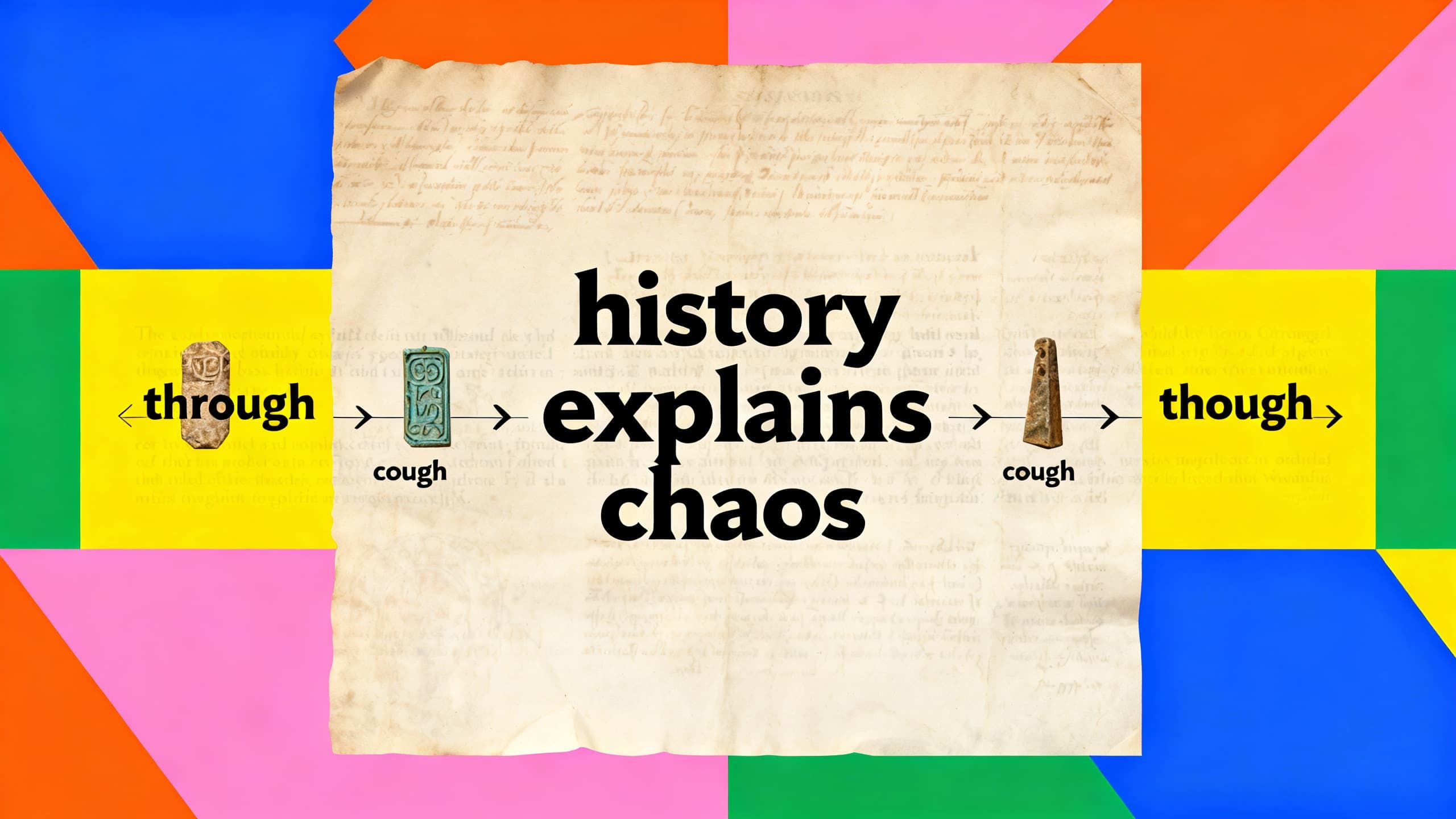
Why is cough pronounced one way, through another, though a third, thought a fourth, and bough a fifth - when they all end in -ough? Why does knight have a silent K, G, and H? Why can the same oo sound be spelled food, mood, blue, new, through, to, do, true, and shoe? And why, when you look at the words know, knife, knee, knot, and knock, would any sane language include a letter that nobody pronounces?
If you've ever asked these questions - whether as a frustrated student, a struggling speller, an ESL learner battling English's inconsistencies, or a curious adult wondering how things got this bad - you're asking the right question. English spelling isn't random, even though it feels that way. It's the product of 1,500 years of history: invasions, borrowings, migrations, printing technology, and deliberate (sometimes misguided) reform efforts.
Understanding why English spelling is so chaotic doesn't automatically make it easier to spell - but it does explain the patterns behind the madness. Once you know why knight has that silent K (it was pronounced a thousand years ago), or why debt has a silent B (Renaissance scholars inserted it to show Latin origins), the spellings become less mystifying. English spelling is a historical record, a time capsule, an archaeological site full of layers from different eras.
This is the story of how English spelling got so weird - and why, despite everything, it still makes a certain kind of sense.
Act I: Old English (450–1100 AD) - When Spelling Made Sense
English began as a group of related Germanic dialects brought to Britain by Anglo-Saxon invaders in the 5th century. These early settlers - Angles, Saxons, and Jutes - pushed out the native Celtic speakers and established what we now call Old English.
Spelling Matched Pronunciation
Old English spelling was relatively straightforward. Monks adapted the Latin alphabet to write their language, and they wrote what they heard. Spelling was phonetic - each letter represented a sound.
The word knight was spelled cniht and pronounced approximately "k'nicht" (with the guttural "ch" sound, like German ich). The word write was writan, with a pronounced W. Knee was cneo, with a pronounced K. Every letter earned its place.
What Old English Looked Like
Here's the opening of the Lord's Prayer in Old English:
Fæder ure, þu þe eart on heofonum, si þin nama gehalgod.
Even with strange letters (like þ, which made the "th" sound), spelling reflected pronunciation quite consistently. If you knew the sounds, you could spell the words.
Why This Matters for Modern Spelling
Many of English's "silent letters" were pronounced in Old English. The K in knight, the W in write, the G in gnat - these are fossils of Old English pronunciation, preserved in spelling long after the sounds disappeared.
Act II: The Norman Conquest (1066) - French Arrives
In 1066, William the Conqueror invaded England from Normandy (in modern France). The Norman Conquest brought French-speaking rulers, clergy, and administrators. For the next 300 years, French was the language of power, law, and culture in England.
Two Languages Collide
English didn't disappear - it continued as the language of common people. But it absorbed thousands of French words, especially in areas like government (court, judge, parliament), military (army, battle, soldier), religion (priest, saint, prayer), and food (beef, pork, mutton).
Along with French vocabulary came French spelling conventions. Norman scribes - the people who actually wrote documents - introduced changes:
The "gh" Problem
Old English had a sound written as h that was pronounced like the German "ch" (in Bach). Norman scribes, unfamiliar with this sound, replaced h with gh to make it look more familiar to French eyes. This is why we have:
- night (Old English niht)
- right (Old English riht)
- light (Old English leoht)
- through (Old English þurh)
The irony is that the gh eventually became silent anyway - but the spelling stuck.
The "qu" Change
Old English wrote the "kw" sound as cw (cwen for "queen"). French scribes changed this to qu, which is why modern English has queen, quick, quiet instead of cween, cwick, cwiet.
The Silent B in doubt
Some words gained letters they'd never had. Doubt came from French doute, with no B. But Renaissance scholars (we'll get to them later) added a B to show the Latin root dubitare. The B was never pronounced in English - it was added for prestige.
Act III: The Great Vowel Shift (1400–1700) - Pronunciation Changes, Spelling Doesn't
Between roughly 1400 and 1700, something remarkable happened to English: all the long vowel sounds shifted systematically. This is called the Great Vowel Shift, and it's one of the main reasons English spelling seems so disconnected from pronunciation.
What Happened
Long vowels moved around in the mouth like a game of musical chairs:
- The sound in bite used to be pronounced like "beet"
- The sound in meet used to be pronounced like "mate"
- The sound in name used to be pronounced like "nam" (rhyming with "calm")
- The sound in house used to be pronounced like "hoose"
These shifts happened over generations - grandparents and grandchildren pronounced the same words differently. But by the time the shifts stabilized, English spelling had already been fixed in print.
Why Spelling Didn't Follow
The timing was catastrophic for spelling. The printing press arrived in England in 1476, right in the middle of the Great Vowel Shift. Early printers standardized spellings based on how words were pronounced in their time - but pronunciation kept changing after spelling was fixed.
This is why English spelling reflects pronunciation from 500 years ago, not modern speech. When you spell meat and meet differently (even though they sound identical today), you're preserving a distinction that existed in Middle English. When you spell name with a silent E, you're using a spelling convention from before the vowel shift.
Act IV: The Printing Press (1476) - Standardization Without Logic
William Caxton set up England's first printing press in 1476, and this technology would freeze English spelling in place. Before printing, spelling was fluid - the same word might be spelled differently in the same document. Printing demanded consistency.
The Standardization Problem
Early printers weren't linguists. They were businessmen who needed to produce readable books. They standardized spellings based on:
- How words were currently pronounced (which kept changing)
- How words looked in older manuscripts
- Their own personal preferences
- Space considerations (adding or removing letters to justify margins)
Dutch Printers and Their Quirks
Caxton and many early English printers were trained in the Low Countries (modern Netherlands and Belgium). Dutch printing conventions influenced English spelling:
- Ghost acquired its H from Dutch gheest (the Old English was just gast)
- Ghastly followed ghost
These were spelling changes made by foreign typesetters, not English language evolution.
Printing Made Spelling Permanent
Once books were printed and distributed, spellings became fixed. People learned to spell by reading printed texts, and variant spellings started to look "wrong." The chaos of early decisions became permanent.
Act V: The Renaissance (1500–1650) - Making Words Look Latin
During the Renaissance, English scholars developed an inferiority complex about their language. Latin and Greek were the languages of learning, and many scholars felt English should reflect its classical roots.
Silent Letters for Prestige
Scholars added letters to English words to show their Latin or Greek origins - even though these letters were never pronounced:
- Debt came from French dette, but scholars added B to match Latin debitum
- Receipt came from French receite, but got a P for Latin receptum
- Island was spelled iland (and related to Old English iegland), but scholars added an S because they thought it came from Latin insula (it didn't)
- Scissors got a C for Latin scissor (correctly, in this case)
- Anchor got an H for Greek ankura
Some of these changes were historically accurate (Latin debitum does have a B). But the letters were never pronounced in English - they were just visible reminders of classical heritage.
The Cult of Etymology
This trend treated spelling as a display of learning. A word should show where it came from, not just how it sounded. The result was spellings that looked impressive but didn't help pronunciation at all.
Act VI: Samuel Johnson's Dictionary (1755) - Fixing the Chaos
By the 18th century, English spelling was a mess. Writers spelled words inconsistently, and there was no authoritative reference. In 1755, Samuel Johnson published his Dictionary of the English Language, which would shape English spelling for the next 200+ years.
Johnson's Approach
Johnson didn't try to reform spelling - he tried to document it. He chose spellings based on:
- Current educated usage
- Historical precedent
- Etymology (when he could determine it)
- His personal preferences
Where multiple spellings existed, Johnson picked one and made it standard. His dictionary became the authority, and printers, teachers, and writers followed it.
Preserving the Chaos
Johnson's conservative approach preserved most of the historical oddities that had accumulated. He didn't simplify night to nite or through to thru. He kept silent letters, irregular patterns, and etymological spellings because they were already in use.
Johnson famously defended English's inconsistencies, arguing that spelling should reflect history and usage rather than logic alone.
Act VII: American English - Webster's Partial Reforms
Across the Atlantic, Noah Webster had different ideas. When he published his American Dictionary of the English Language (1828), he deliberately simplified some spellings to make American English distinct from British English.
Webster's Changes
Webster's reforms created the British/American spelling differences we know today:
- colour → color
- honour → honor
- centre → center
- theatre → theater
- defence → defense
- travelled → traveled
- organise → organize (standardized)
These changes made American spelling slightly more phonetic. Webster wanted to go further - he proposed wimmin for women, tung for tongue, and masheen for machine - but these more radical reforms didn't catch on.
Why Reform Is Hard
Webster's limited success shows why spelling reform is difficult. Once spellings are established and taught in schools, printed in millions of books, and embedded in culture, change faces enormous resistance. We're still living with 15th-century spelling conventions because the cost of change seems higher than the cost of learning the system we have.
For more on British/American differences: British vs American Spelling: The Complete Guide
Why English Never Reformed Its Spelling
Other languages have successfully reformed their spelling. German, Dutch, and Russian have all modernized their orthographies. Portuguese and Spanish have updated their systems. Why not English?
No Central Authority
English has no Académie Française equivalent - no official body that can mandate spelling changes. Attempts at reform have always been voluntary, and they've never achieved critical mass.
Too Many English Speakers
English is spoken natively in multiple countries (US, UK, Australia, Canada, Ireland, New Zealand, etc.) and as a second language by billions more. Coordinating reform across all these populations is essentially impossible.
The Cost Is Too High
Consider what reform would require:
- Reprinting millions of books
- Retraining every literate person
- Updating every written document
- Changing every sign, every product label, every website
The transition costs are staggering, especially for changes that would feel unfamiliar and uncomfortable.
Partial Reform Creates More Chaos
If the US reformed and the UK didn't (or vice versa), we'd have even more variation to manage. Half-measures might make things worse.
People Get Used to Chaos
Eventually, speakers internalize irregular spellings. They stop noticing that knight is weird because they learned it in childhood. The chaos becomes invisible - which removes the urgency to fix it.
How This History Helps You Spell
Understanding English spelling history won't automatically make you a better speller, but it offers practical benefits:
Silent Letters Become Memorable
When you know the K in knight was once pronounced, you understand why it's there. You're not memorizing an arbitrary letter - you're remembering a historical fact. History provides meaning, and meaning aids memory.
Patterns Emerge from Chaos
The "chaos" of English spelling follows patterns once you know where to look:
- -ight words (light, night, right, sight, fight) all share Old English origins and that Middle English gh
- -tion endings (nation, education, station) reflect Latin -tio suffixes
- Silent B after M (climb, lamb, thumb) reflects Old English consonant clusters
Etymology Becomes a Tool
Connecting words to their origins helps spelling:
- sign has a silent G, but signature has an audible G - same root
- bomb has a silent B, but bombard pronounces it - same root
- muscle looks like mussel, but knowing it comes from Latin musculus (little mouse - muscles looked like mice under the skin) makes the C make sense
You Stop Fighting the System
Instead of asking "Why is this so stupid?", you can ask "When did this spelling decision get made?" Accepting that English spelling is historical rather than logical reduces frustration and frees mental energy for actually learning the spellings.
The Silver Lining: English Spelling Has Benefits
Despite the complaints, English spelling has some advantages:
Words Look Like Their Relatives
Because English preserves historical spellings, related words look similar even when they sound different:
- sign, signal, signature, significant
- bomb, bombard, bombardment
- medicine, medical, medicate
If we spelled phonetically, these connections would be invisible.
Different Meanings Get Different Spellings
Homophones that sound identical are distinguished in writing:
- their, there, they're
- right, write, rite, wright
- meet, meat, mete
In speech, context disambiguates. In writing, spelling does. This can actually aid reading comprehension.
English Absorbs Foreign Words Easily
English borrows words from every language and often keeps their original spellings. Sushi, entrepreneur, kindergarten, khaki - these spellings signal origin. English's flexibility has made it an international lingua franca.
We Can Still Read Old Texts
Because spelling hasn't changed radically, modern English readers can access texts from centuries ago. Shakespeare's First Folio (1623) is challenging but readable. Try reading 400-year-old French or German without training - it's much harder.
The Future of English Spelling
Will English ever reform? Probably not dramatically, but small changes continue:
Texting and Digital Communication
Abbreviated spellings (u, 2, thru, nite) are common in casual digital contexts. Some may eventually become standard - but this seems unlikely for formal writing anytime soon.
AI and Autocorrect
Technology makes spelling easier to manage without reforming the system. If autocorrect can fix errors instantly, there's less pressure to simplify spelling itself.
Drift, Not Reform
English spelling will probably continue to drift slowly - small changes accumulating over generations - rather than reforming dramatically. Future English speakers may accept spellings we'd find odd, just as we accept spellings that baffled previous generations.
Embracing the Chaos: A Practical Approach
Understanding history is interesting, but you still need to spell correctly. Here's how to use this knowledge practically:
Learn in Families
Group words by historical origin or pattern:
- The -ight family: light, night, right, sight, fight, might, bright, flight
- The kn- family: know, knife, knee, knock, knight
- The -tion family: nation, education, station, action, relation
For more patterns: The 7 Most Important English Spelling Patterns Every Learner Should Know
Use Etymology as a Memory Hook
When learning a tricky word, look up its history:
- Island has an S because scholars thought it came from insula (it didn't)
- Debt has a B because scholars added it for Latin debitum
- Wednesday comes from "Woden's Day" - that's where the invisible D comes from
The story helps the spelling stick.
Accept That Memorization Is Unavoidable
No amount of rules will eliminate the need to memorize some spellings. English spelling is partly pattern-based and partly word-specific. Embrace both.
Use Modern Tools
Spaced repetition, spelling apps, and regular practice work regardless of how illogical the system is. The system isn't going to change - but your mastery of it can improve.
For practice strategies: The 10-Minute Daily Spelling Practice Routine
Conclusion: English Spelling Is History Made Visible
English spelling isn't random - it's historical. Every silent letter, every odd pattern, every frustrating inconsistency has a story. The K in knight is an Anglo-Saxon fossil. The GH in night is a Norman scribe's notation. The B in debt is a Renaissance scholar's pretension. The "illogical" vowels in meat and meet preserve a distinction that existed 500 years ago.
This history doesn't make spelling easier, but it makes it more interesting. And for some learners, understanding why helps with remembering how.
English spelling is a time machine, a linguistic archaeology site, a record of invasions and borrowings and technological changes and reform efforts. It's messy because English history is messy. It's complex because English absorbed complexity from Latin, Greek, French, Old Norse, and dozens of other languages.
The spelling chaos you inherited isn't stupidity - it's legacy. Every word carries its history in its letters. And once you start seeing spelling as a window into the past rather than an arbitrary burden, the whole system becomes a little less frustrating and a lot more fascinating.
Related Reading on Spelling.School
For Practical Spelling Help
- Commonly Misspelled Words (and Tricks to Remember Them)
- The 7 Most Important English Spelling Patterns Every Learner Should Know
- The 10-Minute Daily Spelling Practice Routine