How to Prepare for TOEFL Spelling: The Words That Trip Up Test-Takers
January 24th, 2026
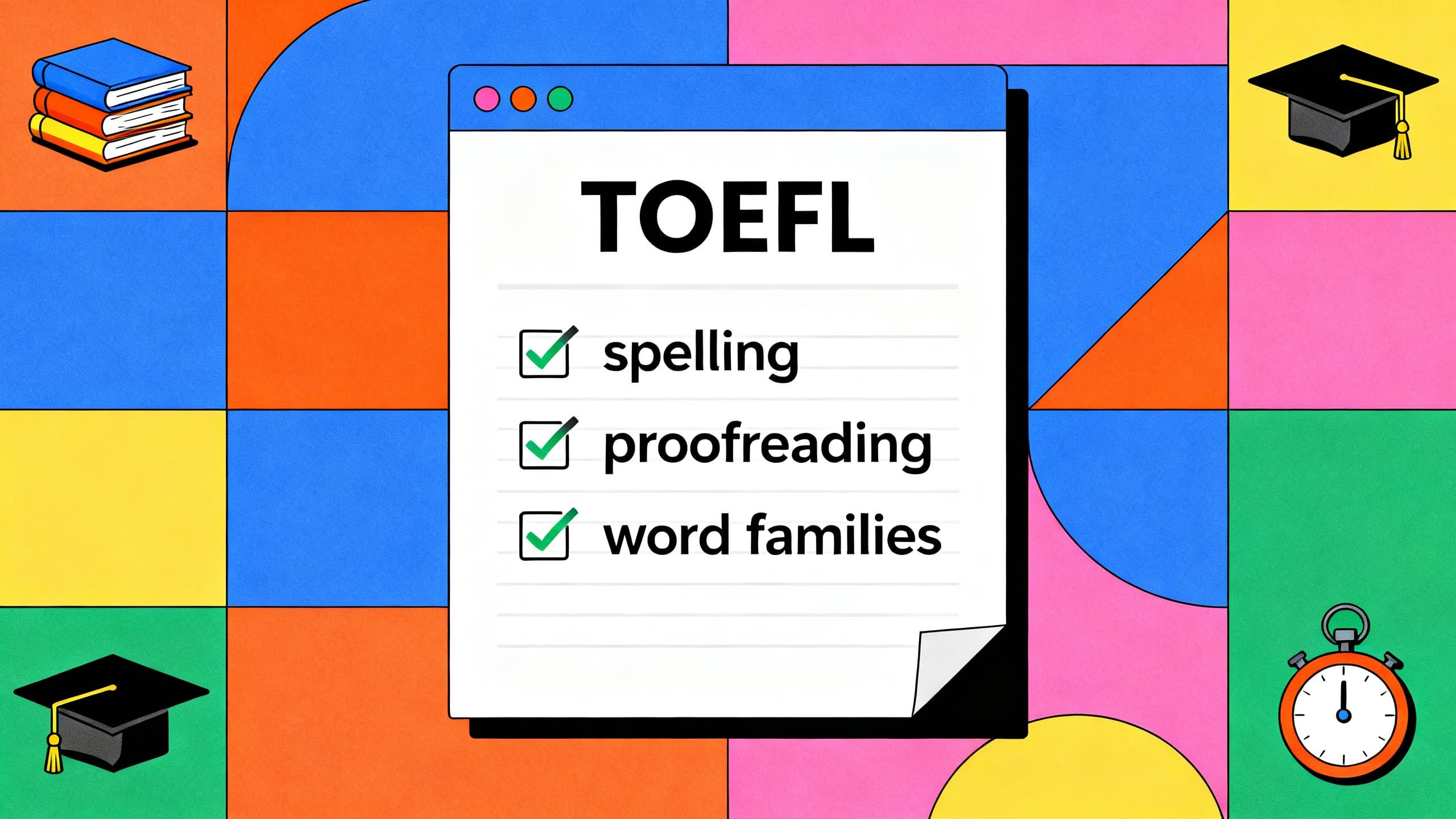
How to Prepare for TOEFL Spelling: The Words That Trip Up Test-Takers
If you're preparing for the TOEFL, you've probably spent hours working on reading comprehension, listening skills, speaking fluency, and essay structure. But how much time have you devoted to spelling? For many test-takers, the answer is "almost none" - and that's a costly mistake.
TOEFL spelling matters more than many candidates realize. While there's no dedicated spelling section on the exam, spelling directly affects your Writing score and can influence your Listening section performance if you're taking the TOEFL in a format that requires written responses. Misspelled words in your essays signal weak language control, and in listening sections where you must type what you hear, incorrect spelling means incorrect answers.
The good news is that TOEFL spelling challenges are predictable. The test uses academic vocabulary - words related to education, science, social studies, history, and the arts - and these words follow patterns. If you know the 200-300 most commonly misspelled academic words and understand the patterns behind them, you'll eliminate most spelling errors that cost test-takers points.
This guide is specifically designed for TOEFL preparation. It covers the spelling challenges unique to the TOEFL, the most commonly misspelled words in academic contexts, strategies for improving spelling under test conditions, and a practical study plan you can follow in the weeks before your exam.
How Spelling Affects Your TOEFL Score
The Writing Section
TOEFL Writing is scored on multiple criteria, and language use is one of them. Spelling falls under language use - specifically, vocabulary control and accuracy. Here's how spelling impacts your Writing score:
Minor occasional errors: The TOEFL scoring rubric expects even high-scoring essays to have occasional minor errors. One or two spelling mistakes in an otherwise strong essay won't dramatically hurt your score.
Frequent or pattern errors: If you repeatedly misspell common academic words, or if your spelling errors appear throughout the essay, raters will note weak language control. This can push you from a 4 to a 3 in Language Use.
Errors that affect meaning: Spelling errors that change meaning (like writing "affect" when you mean "effect," or "compliment" when you mean "complement") are more serious because they suggest confusion, not just typos.
Overall impression: Essays with clean spelling simply read more professionally. They suggest a writer who has command of academic English. This creates a positive impression that influences how raters perceive your other skills.
The Listening Section
In some TOEFL formats, you may need to type words you hear. If you misspell them, the answer is wrong - there's no partial credit. This is especially challenging because:
- You're spelling under time pressure
- You're spelling words you've only heard, not seen
- Academic vocabulary often has surprising spellings (silent letters, unstressed vowels, double consonants)
The Bottom Line
Spelling isn't scored separately, but it affects your performance across sections. Investing a few hours in targeted spelling practice yields direct returns on test day.
TOEFL vs. IELTS: Spelling Differences to Know
If you're also considering IELTS or comparing the two exams, here are the key spelling-related differences:
American vs. British Spelling
TOEFL is an American test, so American spelling is standard:
- color (not colour)
- organize (not organise)
- center (not centre)
- traveling (not travelling)
IELTS is British by origin but accepts both American and British spelling, as long as you're consistent.
If you've been studying with British materials, make sure you know the American variants for TOEFL. For a complete guide to the differences: British vs American Spelling: The Complete Guide (And Which One to Use)
Vocabulary Focus
TOEFL vocabulary tends toward American academic contexts: university settings, campus life, American history, North American geography. IELTS vocabulary is more internationally varied. This means some words appear more frequently on one test than the other, but the core academic vocabulary overlaps significantly.
Writing Format
TOEFL Writing is typed. IELTS Writing is handwritten (for paper-based) or typed (for computer-based). Typed spelling can be both easier (fewer formation errors) and harder (faster writing = more typos, and autocorrect may be disabled).
For IELTS-specific guidance, see: The Hidden Reason IELTS Candidates Lose a Whole Band: Spelling
The Categories of Words TOEFL Test-Takers Misspell Most
TOEFL spelling challenges fall into predictable categories. Understanding these patterns helps you target your preparation efficiently.
Category 1: Academic Vocabulary with Unstressed Vowels (Schwa)
Academic words are often long and have unstressed syllables where the vowel sounds like "uh" regardless of how it's spelled. This creates guessing games in spelling.
High-frequency TOEFL words with schwa problems:
- separate (not seperate)
- definite / definitely (not definately)
- government (not goverment)
- environment (not enviroment)
- independent (not independant)
- category (not catagory)
- grammar (not grammer)
- calendar (not calender)
- similar (not similer)
- particular (not particlar)
Memory strategies:
- Connect to related words: define → definite → definitely
- Use memory tricks: "There's a RAT in sepA RATe"
- Chunk the visual pattern: gov-ern-ment, en-vi-ron-ment
Category 2: Double Consonants
English doubles consonants in ways that feel arbitrary to non-native speakers. TOEFL academic vocabulary includes many double-consonant words.
High-frequency TOEFL words with double letters:
- accommodate, accommodation
- recommend, recommendation
- occur, occurred, occurrence
- success, successful, successive
- necessary, necessarily, necessity
- possess, possession, possible
- professional, professor
- committee
- different, difference
- opportunity
- beginning
- aggressive, aggression
Memory strategies:
- Learn word families together: occur → occurred → occurring → occurrence (all double r)
- Use patterns: "One collar (c), two socks (ss)" for necessary
- Memorize the hardest ones with mnemonics: accommodate = "cc" + "mm" (it accommodates doubles)
Category 3: Suffix Confusions (-tion/-sion, -ance/-ence, -able/-ible)
Suffixes that sound similar but are spelled differently cause frequent TOEFL errors.
-tion vs. -sion:
- -tion is more common: education, information, organization, population, tradition, variation, preparation
- -sion appears after certain base forms: decision, conclusion, discussion, expansion, expression, division, revision
-ance vs. -ence:
- -ance: importance, performance, appearance, maintenance, significance, attendance, resistance
- -ence: difference, experience, existence, occurrence, reference, preference, consequence, influence
-able vs. -ible:
- -able often attaches to complete English words: comfortable, dependable, acceptable, reasonable, considerable
- -ible usually attaches to Latin roots: possible, responsible, flexible, visible, accessible, incredible
Memory strategies:
- When in doubt, -tion is more common than -sion
- Create lists grouped by suffix pattern
- Learn verb → noun pairs: decide → decision, discuss → discussion, educate → education
Category 4: Silent Letters
Academic vocabulary includes many words with letters that aren't pronounced.
High-frequency TOEFL words with silent letters:
- know, knowledge, acknowledge (silent k)
- psychology, psychologist (silent p)
- foreign (silent g)
- sign, signature, significant (silent g in base)
- answer (silent w)
- doubt, subtle (silent b)
- island (silent s)
- listen, fasten (silent t)
- column (silent n)
For a complete guide: Silent Letters in English: A Complete Guide to Words You Can't Sound Out
Category 5: Common Academic Homophones
Homophones are words that sound alike but are spelled differently. Using the wrong one shows confusion, not just spelling weakness.
High-frequency TOEFL homophones:
- affect (verb) / effect (noun/verb)
- principal (main; school head) / principle (rule, truth)
- site (location) / sight (vision) / cite (reference)
- complement (complete) / compliment (praise)
- stationary (not moving) / stationery (paper)
- proceed (go forward) / precede (come before)
- accept (receive) / except (exclude)
- passed (verb) / past (noun/adj/prep)
For a complete guide: Homophones That Confuse Everyone: Their, There, They're and 50 More
The 100 Most Important Words for TOEFL Spelling
Here's a targeted list of the words that appear frequently on TOEFL and are commonly misspelled. Master these before test day.
Academic Process Words
- analyze / analysis
- argue / argument
- assess / assessment
- categorize / category
- compare / comparison
- conclude / conclusion
- describe / description
- develop / development
- discuss / discussion
- evaluate / evaluation
- examine / examination
- explain / explanation
- organize / organization
- summarize / summary
Frequency and Quantity Words
- approximately
- majority / minority
- particularly
- significantly
- substantially
- sufficient / insufficient
Cause and Effect Words
- affect / effect
- consequence / consequently
- impact
- influence
- result
Agreement and Contrast Words
- although
- however
- nevertheless
- nonetheless
- whereas
- conversely
Knowledge and Education Words
- acknowledge
- acquire / acquisition
- curriculum
- discipline
- environment
- experience
- intelligence
- knowledge
- laboratory
- library
- literature
- psychology
- university
Description and Quality Words
- accurate / accuracy
- appropriate
- available / availability
- beneficial / benefit
- characteristic
- considerable
- consistent / consistency
- efficient / efficiency
- essential
- independent / independence
- necessary / necessity
- obvious / obviously
- opportunity
- particular / particularly
- permanent
- previous / previously
- professional
- relevant / relevance
- responsible / responsibility
- separate / separately
- similar / similarity
- specific / specifically
- sufficient
- temporary
Action and Process Words
- achieve / achievement
- accommodate / accommodation
- accompany
- accomplish
- acquire / acquisition
- communicate / communication
- establish / establishment
- guarantee
- implement / implementation
- maintain / maintenance
- occur / occurred / occurrence
- possess / possession
- proceed
- recommend / recommendation
- succeed / success / successful
Strategies for Spelling Under Test Conditions
TOEFL is a timed test. You can't spend minutes deliberating over spelling. Here are strategies for managing spelling during the exam:
1. Pre-Build Your "Safe" Vocabulary
Identify 50-100 academic words you're confident you can spell. Use these as your go-to vocabulary for essays. When you have a choice between a word you're unsure about and one you know, choose the one you know.
2. When in Doubt, Simplify
If you're unsure how to spell accommodate, you could write provide for or make room for. If necessary feels risky, try needed. Simpler words spelled correctly beat complex words spelled wrong.
3. Leave Time for Proofreading
In the Writing section, plan to spend 2-3 minutes at the end of each task proofreading specifically for:
- Common spelling errors (your personal weaknesses)
- Homophone mistakes (their/there/they're, your/you're, etc.)
- Missing or extra letters
4. Use Chunking Under Pressure
When spelling a difficult word, break it into chunks mentally:
- en-vi-ron-ment
- ac-com-mo-da-tion
- rec-om-mend-a-tion
This slows you down slightly but reduces errors on words that trip you up.
5. Don't Rely on Autocorrect
TOEFL testing conditions may or may not have autocorrect enabled. Practice without it. Get comfortable producing correct spellings from your own memory.
A 4-Week TOEFL Spelling Study Plan
Week 1: Diagnosis and Category Focus
Days 1-2: Take a diagnostic test. Write the 100 most important words from memory. Identify your weak categories.
Days 3-4: Focus on unstressed vowels (schwa). Practice words like separate, definitely, government, environment. Use memory tricks.
Days 5-7: Focus on double consonants. Practice word families: occur/occurred/occurrence, recommend/recommendation, success/successful.
Daily practice: 10-15 minutes. Use the 10-minute routine.
Week 2: Suffix Patterns and Silent Letters
Days 8-10: Suffix patterns. Practice -tion/-sion words, -ance/-ence words, -able/-ible words. Create grouped lists.
Days 11-14: Silent letters. Learn the kn-, wr-, -mb patterns. Practice academic words like knowledge, psychology, foreign.
Daily practice: Continue 10-15 minutes. Add dictation practice (listen to words, write them).
Week 3: Homophones and Integrated Practice
Days 15-17: Homophones. Focus on academic homophones: affect/effect, principal/principle, cite/site/sight. Use in sentences.
Days 18-21: Integrated writing practice. Write TOEFL-style essays and proofread for spelling. Identify errors that slip through.
Daily practice: Include full writing tasks with spelling self-evaluation.
Week 4: Review and Test Simulation
Days 22-24: Review weak areas. Return to categories that gave you the most trouble. Do targeted practice.
Days 25-28: Timed practice. Simulate test conditions. Write essays with time limits and proofreading phases. Track spelling accuracy.
Day 29-30: Light review. No new learning. Revisit your personal trouble words. Rest before the test.
Common TOEFL Writing Topics and Their Vocabulary
TOEFL essays often address similar themes. Here's vocabulary by topic with spelling guidance:
Education Topics
- curriculum, academic, discipline, university
- professor, professional, achievement
- independent, education, knowledge, intelligence
- laboratory, library, literature
Environment Topics
- environment, environmental, ecology
- pollution, conservation, resources
- sustainable, climate, atmosphere
- species, ecosystem, natural
Technology Topics
- technology, technological, development
- communication, innovation, access
- efficiency, automatic, digital
- significant, consequences
Society Topics
- government, community, responsibility
- democracy, economy, economic
- population, immigration, discrimination
- opportunity, equality, tradition
Science Topics
- hypothesis, theory, experiment
- analysis, analyze, conclusion
- evidence, scientific, laboratory
- psychology, biology, chemistry
Listening Section Spelling Challenges
If your TOEFL format requires you to type answers in the Listening section, spelling becomes critical. You'll hear words and need to write them correctly.
Challenges Specific to Listening
- You've never SEEN the word: You may have heard phenomenon but never spelled it.
- Homophones are invisible: "Site" and "sight" sound identical.
- Time pressure: You can't pause and think.
- Unstressed syllables are unclear: You might hear "gover-ment" and miss the "n" before "ment."
Preparation Strategies
-
Study with audio AND text: When learning vocabulary, hear the word and see the spelling together. This builds audio-visual connections.
-
Do dictation practice: Have someone read academic sentences while you type them. Check against the original. This simulates test conditions.
-
Learn common phonetic traps: Know which sounds are easily misspelled (schwa, silent letters, double consonants) and be extra careful with those words.
-
Build a "listening spelling" list: Words you recognize when reading but might misspell when hearing. Practice these specifically.
Technology During TOEFL Preparation
Apps and Tools
Use spelling apps that employ spaced repetition to build long-term memory. Look for apps that:
- Force you to produce the spelling (not just recognize it)
- Adapt to your personal trouble words
- Include academic vocabulary
For recommendations: The Best Spelling Apps for ESL Learners in 2025
Typing Practice
Since TOEFL Writing is typed, practice typing accurately. Typing errors (transposed letters, missed letters, double-struck keys) are spelling errors on the test. Practice typing quickly AND accurately.
Autocorrect Training
Turn off autocorrect when practicing. You need to know your real spelling ability without support. This reveals your true weaknesses.
Test Day Spelling Tips
Before the Test
- Review your personal trouble words one more time (quick, not intense)
- Trust your preparation
- Get good sleep (tired brains make more errors)
During the Test
- Don't rush writing so fast that you make careless errors
- Use your "safe" vocabulary for important points
- Leave time to proofread at the end of writing tasks
- If unsure about a spelling, consider if there's a synonym you're confident about
During Proofreading
- Read your essay slowly, word by word
- Look specifically for your known weaknesses
- Check homophone usage (their/there/they're, affect/effect)
- Fix any obvious typos
FAQ: TOEFL Spelling Questions
"How much can spelling hurt my TOEFL score?"
Spelling alone won't make or break your score, but cumulative errors reduce your Language Use rating. If you have many spelling errors alongside grammar errors, you'll score lower in that criterion. Clean spelling creates a positive impression that supports your overall score.
"Should I use simple words to avoid spelling mistakes?"
Use vocabulary appropriate to the task. Don't oversimplify just because you're afraid of spelling errors. But if you're choosing between two equally good words and you're confident in one, choose the confident option.
"Can I use British spelling on TOEFL?"
American spelling is expected. While one or two British spellings probably won't hurt you, consistent American spelling is the safe choice. Learn the main differences (color/colour, organize/organise, center/centre, traveled/travelled).
"I'm running out of time - should I proofread or write more?"
If you have 3+ minutes, some proofreading is worthwhile. Catching a few obvious errors can improve your impression. But don't sacrifice significant content for proofreading. Balance is key.
Conclusion: Spelling Is Part of TOEFL Success
TOEFL tests your ability to use English in academic contexts, and spelling is part of academic English competence. While it's not tested directly, spelling affects your Writing score, potentially affects Listening if you're typing responses, and shapes the overall impression your essays create.
The good news is that TOEFL spelling is predictable. Academic vocabulary follows patterns, and the words that cause the most trouble are known. By targeting your practice on:
- High-frequency academic words
- Known pattern challenges (schwa, double letters, suffixes, silent letters, homophones)
- Your personal weak spots
...you can eliminate most spelling errors in 4-6 weeks of focused preparation.
Start now. Identify your weaknesses. Practice with intention. On test day, you'll write with confidence - and that confidence will show in your score.
Related Reading on Spelling.School
For ESL Learners
For Pattern Learning
- The 7 Most Important English Spelling Patterns Every Learner Should Know
- Commonly Misspelled Words (and Tricks to Remember Them)
For IELTS Comparison
- The Hidden Reason IELTS Candidates Lose a Whole Band: Spelling
- How to Study Spelling for IELTS (And Why It Matters More Than Grammar)
For Daily Practice
- The 10-Minute Daily Spelling Practice Routine
- The Science of Spelling: How Spaced Repetition Boosts Memory
Related Guides
-
British vs American Spelling: The Complete Guide (And Which One to Use)
-
Silent Letters in English: A Complete Guide to Words You Can't Sound Out
-
Homophones That Confuse Everyone: Their, There, They're and 50 More
-
The Most Common English Spelling Mistakes Spanish Speakers Make (And How to Fix Them)
-
The Most Common English Spelling Mistakes Chinese Speakers Make (And Memory Tricks That Work)